Essential Oils, The Science Of Soap
Essential oils and their uses. How do we get them?
Dec
An oil is any nonpolar chemical substance that is composed primarily of hydrocarbons and is hydrophobic (does not mix with water) and lipophilic (mixes with other oils). Oils are usually flammable and surface-active. Most oils are unsaturated lipids that are liquid at room temperature.
The above is the Wikipedia definition of oil and generally all oils fall into three categories; Animal, Vegetable and Petrochemical.
At Dawn to Dusk Alchemy we are mainly concerned with vegetable-derived oils, but some of our artisan soaps contain animal “tallows” (we label those that do not as vegan-friendly). It might be noted that where some handmade soaps, ointments and balms have “fragrance” oils added to their constituents, these fragrances are very often synthesised using industrial chemistry and derived from synthetic origins. We don’t not utilise these substances and we only use naturally pure essential oils.
What Are Essential Oils?
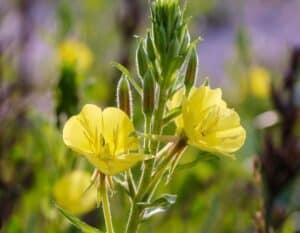
Essential oils are concentrated plant extracts made using steam distillation or other methods. Essential oils are highly potent and should be used with caution. To use essential oils, dilute them in a carrier oil or other base before applying them to the skin. Essential oils can be used topically, aromatically, or internally, depending on the oil.
Essential oils are a good choice for herbs that are difficult to prepare in other ways or that have a strong aroma, such as lavender or tea tree.
Many fruit oils and vegetable oils such as Olive oil, Avocado, Palm oil, Rapeseed oil and most nut oils etc. are extracted by crushing then pressing the fruits, seeds or nuts under high pressure using specially designed presses hydraulically driven to squeeze out the oils. A secondary pressing by adding water or lighter oils then produces a typical “Pomace” oil. Herbs and other forms of plant-derived oils are mostly obtained by steam distillation.
Pure essential oils have a fairly low-temperature vapour point and that is the reason why the manufacturing processes that we use at Dawn to Dusk Alchemy are very carefully temperature-controlled. This property of oils easily lends itself to the process called Steam Distillation. This process is not easily done in a small workshop environment and it is far more convenient to purchase the oils from commercial suppliers.
How We Make Essential Oils
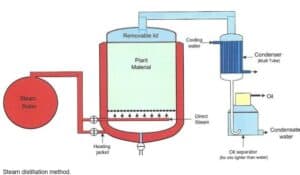
To extract the essential oil from a typical herb or plant, it is mechanically chopped or ground and put into a sealed flask or retort and hot, dry steam introduced. The heat absorbed is sufficient to strip out and vaporise the oils from the vegetation and it then passes through a tube which is usually coiled and of reasonable length. This coiled tube is embedded within a jacket that is fed with a constant flow of cold water or a suitable refrigerant liquid.
The ‘condensate’, then enters a further container at its base and the oil, being lighter than water, floats to the top where it can be drawn off as a complete essential oil. It is usual to filter or centrifuge the oil to remove any solids that may have travelled from the retort before final bulk collection and packaging. The whole process is not unlike the distillation process of whiskey and other spirits and alcohols.
Some essential oils require a vast amount of vegetable matter to realise quite a small quantity of oil, typically rose oil and petal derived oils – which is why those tend to be very expensive oils. In essence, nearly every form of life on the planet contains some sort of oil (some can be quite toxic) with the majority proving to be useful – such as providing the building blocks for our modern drugs and medicines.
Pure essential oils are what we at Dawn to Dusk Alchemy employ to give our products their design properties and fragrances, and we can guarantee that we only use the highest quality tested, and refined oils for your safety, and our high manufacturing standards.
~ Dawn and the Team